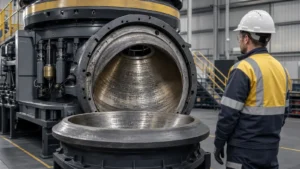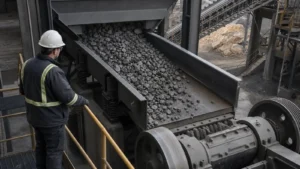
Ore liberation grinding size progression beside a mineral processing ball mill

Ore Liberation and Grinding Size in Beneficiation Circuits

Ore liberation grinding size describes the particle-size range at which valuable mineral grains become sufficiently released or exposed from surrounding gangue for effective beneficiation. Grinding reduces composite ore particles, while classification controls which size fractions leave the circuit. The suitable target depends on mineral texture and the response of flotation, magnetic separation, gravity concentration or … Read more

Wet grinding process with ball mill slurry pump and hydrocyclone classification

Wet Grinding Process in Mineral Processing Plants

The wet grinding process mixes crushed ore with process water inside a grinding mill to form a pumpable mineral slurry. The mill reduces particle size, while the sump, pump and classifier control how the slurry moves through the circuit. Fine material proceeds toward beneficiation, whereas coarse particles return for additional grinding. What Is the Wet … Read more

Ball mill classification circuit with hydrocyclones and slurry return line

Ball Mill Classification Circuit and Return Load in Ore Grinding

A ball mill classification circuit separates mill discharge into a fine product stream and a coarse return stream. The classifier sends particles that meet the process size requirement toward mineral separation, while coarser particles return to the mill for further grinding. This closed material path helps the grinding stage deliver controlled feed to flotation, magnetic … Read more

Construction waste crushing process with mobile crusher magnetic separator and screening plant

Construction Waste Crushing Process for Recycled Aggregate

The construction waste crushing process converts sorted concrete, brick, masonry and selected asphalt material into reusable aggregate fractions through controlled feeding, contaminant removal, crushing, metal separation and screening. A complete line protects the crusher from unsuitable debris, controls particle size and keeps each finished stockpile separate for testing against the required local material specification. Construction … Read more

Crawler mobile crusher operating on a prepared rough-rock quarry bench

Crawler Mobile Crusher Use in Rough Mining Sites

Crawler mobile crusher site use brings feeding, crushing and conveying closer to the rock source when a quarry or mining face changes position. The tracked chassis supports short moves within a prepared site, while the crusher, feeder and discharge conveyor continue to perform defined process duties. This arrangement can reduce repeated raw-material movement before primary … Read more

Mobile crushing and screening plant flow with jaw crusher secondary crusher conveyors and screening plant

Mobile Crushing and Screening Plant Flow for Multi-Stage Production

Mobile crushing and screening plant flow connects feeding, primary reduction, secondary reduction, size classification and product conveying across one or more movable units. Each machine performs a defined process role, while the conveyors determine how material moves between stages and whether oversize returns for further crushing. What Defines a Multi-Stage Mobile Plant Flow? A mobile … Read more

Crushing plant dust control with enclosed transfer points extraction ducts and dust collector

Crushing Plant Dust Control Equipment and Layout Factors

Crushing plant dust control works best when the plant contains dust at its source, captures airborne material through suitable extraction, and uses controlled suppression where water will not damage the process. Layout planning connects these methods across hoppers, crushers, screens, conveyors and stockpile points. Where Dust Forms in a Crushing Plant Dust forms whenever dry … Read more

Impact crushing for limestone with crusher conveyors and screening stage in a quarry plant

Impact Crushing for Limestone and Medium-Hard Stone

Impact crushing for limestone combines secondary size reduction with aggregate shape control in quarry and fixed crushing plants. A well-matched line connects the impact crusher with controlled feeding, conveying and screening so each stage receives a consistent material flow. Why Limestone Suits Impact Crushing Limestone usually breaks effectively under impact force. Inside an impact crusher, … Read more

Jaw crusher feed size control with hopper feeder crusher and conveyor in fixed crushing line

Jaw Crusher Feed Size Control in Fixed Crushing Lines

Jaw crusher feed size control is a key part of stable primary crushing in fixed crushing lines. When the feed entering the crusher is consistent, the crushing chamber works more smoothly, the discharge flow becomes easier to manage and downstream screening can operate with better material continuity. Why Feed Size Control Matters Before the Jaw … Read more

Secondary crushing and screening flow with crusher screen conveyors and aggregate piles

Secondary Crushing and Screening Flow for Aggregate Plants

Secondary crushing and screening connects the middle and final sizing stages of an aggregate plant. After primary crushing, the process reduces stone further, separates finished sizes and returns oversized material to the crusher when another reduction pass is needed. What Secondary Crushing Adds to an Aggregate Plant Primary crushing makes large rock easier to convey, … Read more