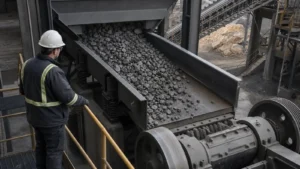
Illustrative uneven rock distribution across a vibrating feeder below a hopper

Vibrating Feeder Uneven Feeding: Causes and Troubleshooting

Vibrating feeder uneven feeding is usually traced by separating three different symptoms: flow that rises and falls over time, material concentrated on one side of the tray, or a hopper that releases batches after temporary blockage. Check hopper discharge, material moisture and size distribution, gate opening, tray loading, buildup, supports, fasteners, drive behavior and downstream … Read more

Illustrative inspection of worn mantle and concave surfaces in a cone crusher chamber

Cone Crusher Liner Wear Patterns: Causes and Inspection

Cone crusher liner wear patterns should be diagnosed by comparing wear around the full mantle and concave, not by judging one polished area. Even wear through the intended crushing zone generally indicates stable material presentation. One-sided wear, a deep local groove, heavy wear only at the top or bottom, cracking, or deformation calls for a … Read more

Engineers evaluating heavy mining equipment manufacturing inside an industrial workshop

How to Evaluate a Mining Equipment Manufacturer’s Factory

A mining equipment manufacturer factory evaluation should verify how the supplier controls design, materials, machining, welding, assembly, inspection, testing and final records. Factory area, employee count and large machine tools indicate potential capacity, but they do not prove that a specific crusher, mill, kiln or processing machine will meet the agreed duty. The strongest evaluation … Read more

Illustrative ball mill cutaway showing mixed grinding media sizes and ore breakage

Ball Mill Grinding Media Size Selection for Ore Grinding Circuits

Ball mill grinding media size selection must balance two duties: media must be large enough to break the coarsest competent feed particles, while the charge must retain enough smaller-media contact to grind the remaining particles toward the target product size. There is no universal ball diameter or fixed size mix. The correct distribution depends on … Read more

Illustrative cone crusher cutaway showing the closed side gap and screening circuit

How Crusher Closed Side Setting Affects Product Size and Circuit Performance

Crusher closed side setting is the smallest gap between the crushing surfaces during the operating cycle. It strongly influences the crusher’s product-size distribution and the load returned by a downstream screen, but it does not equal one guaranteed product size. Chamber geometry, liner wear, feed gradation, material behavior, stroke, speed and chamber loading all affect … Read more

Illustrative vibrating screen separating aggregate across multiple decks

Vibrating Screen Efficiency Factors in Mining and Aggregate Plants

Vibrating screen efficiency factors include feed distribution, bed depth, the proportion of particles close to the aperture size, material moisture and clay, screen-media condition, deck angle, vibration behavior and the time particles remain on the deck. Efficient separation depends on these factors working together. A larger screen or a higher vibration setting cannot correct an … Read more

Illustrative aggregate plant with screening washing dewatering and water recycling

Sand Washing and Screening Flow for Aggregate Production

Sand washing and screening flow connects controlled feeding, particle-size separation, removal of clay or unwanted fines, final classification, dewatering and separate stockpiling. A preliminary screen can remove clean oversize before washing, while wet screening or washing can treat material with attached clay. The correct sequence depends on representative feed gradation, coating behavior, required products, fine-material … Read more

Illustrative rock and alluvial gold ore beneficiation equipment routes

Gold Ore Beneficiation Equipment Flow for Rock and Alluvial Ore

Gold ore beneficiation equipment flow depends first on whether the feed is consolidated rock ore or unconsolidated alluvial material. Rock gold normally requires staged crushing and grinding before gravity concentration, flotation or a professionally engineered downstream extraction stage. Alluvial gold usually requires washing, scrubbing, screening, desliming and size-controlled gravity concentration. Mineralogy, gold occurrence, particle size, … Read more

Illustrative ore beneficiation plant with flotation cells and wet drum magnetic separator

Flotation and Magnetic Separation in Ore Beneficiation

Flotation and magnetic separation use different mineral properties. Flotation separates particles through differences in surface wettability and bubble attachment after slurry conditioning. Magnetic separation uses differences in magnetic susceptibility and particle response to a magnetic field. Neither method is universally better: mineralogy, liberation, particle size, water chemistry and beneficiation testwork determine whether a circuit should … Read more

Illustrative ore plant with vibrating screen oversize return crushing and ball mill feed

Screening Before Grinding in Ore Processing Plants

Screening before grinding separates crushed ore that already meets the mill-feed requirement from oversize that still needs reduction. Screen undersize moves to fine-ore storage or controlled mill feed, while oversize returns to a crusher. This limits unnecessary breakage, controls the maximum feed size and gives the grinding circuit a more consistent size distribution. The actual … Read more