
Rotary dryer residence time is the period solids spend between entering and leaving the drum, but a working dryer does not give every particle the same time. Engineers should consider both mean residence time and the residence-time distribution. Drum geometry, slope, speed, flights, solids loading, gas flow and material properties interact, so one published equation or nominal machine value cannot replace measurement under representative duty.

Mean Residence Time Is Not the Whole Distribution
The general IUPAC definition of residence time describes the time required to pass from an entrance to an exit and notes the common volume-to-flow approximation. For bulk solids in a flighted dryer, however, particles are repeatedly lifted, carried, dropped, mixed and advanced. Some leave earlier than the mean, while others remain longer.
Mean residence time is useful for mass balance and first comparison. The residence-time distribution shows the spread. A broad distribution can contain both short-residence particles that leave wetter and long-residence particles exposed to more drying, even when the average appears acceptable. This distinction matters when investigating variable product moisture or temperature.
Variables That Control Solids Transport
| Variable | Transport Mechanism | Evidence to Record | Why Direction Is Not Always Universal |
|---|---|---|---|
| Drum slope and geometry | Gravity and available travel length influence axial movement. | Verified dimensions, installed slope and internal arrangement. | Flights, end restrictions and loading can change the simple geometric tendency. |
| Rotation speed | Speed changes lifting frequency, bed motion and cascade behavior. | Actual speed, drive condition and material-motion observations. | The response depends on filling, flights and material flow properties. |
| Flights and internals | Flight shape, spacing and loading divide solids between bed, flight-borne and airborne states. | Internal arrangement, wear, buildup and loading condition. | A flight profile that works for one material may load differently with another. |
| Solids feed and holdup | The inventory and feed rate determine how much material occupies the drum and competes for transport paths. | Calibrated feed rate, stable holdup estimate and discharge rate. | Research reports differing feed-rate effects across loading regimes and dryer designs. |
| Particle properties | Size, density, shape, moisture, cohesion and friction affect lifting, falling, sliding and drag. | Representative particle-size, bulk-density, moisture and flowability data. | A mixed feed produces a distribution of particle paths rather than one response. |
| Gas flow | Gas drag can assist or oppose axial solids movement depending on flow direction and particle behavior. | Flow direction, measured gas rate, pressure and air-leakage condition. | Drag significance changes strongly with particle size, density and airborne fraction. |
Flights Create Active and Passive Solids Zones
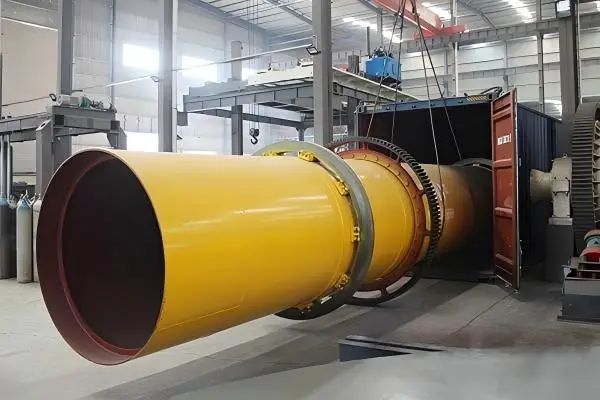
Inside a flighted rotary dryer, some solids remain in the bed or on the flights while another fraction cascades through the gas stream. Heat and mass transfer are not identical in these zones. Flight loading changes as the drum rotates and as moisture or flowability changes, so internal design affects both transport and drying exposure.
Wear, deformation or material buildup on flights can alter the distribution without any change to nominal drum speed or slope. A residence-time investigation should therefore include internal inspection records when the equipment can be safely isolated and accessed.
How to Measure Rotary Dryer Residence Time
Holdup divided by throughput
At stable conditions, measured solids inventory divided by dry-solids mass flow gives a practical mean-time estimate. The method does not reveal early or late particle fractions and becomes unreliable when inventory or throughput is changing.
Tracer pulse test
Introduce a suitable detectable tracer under an approved test plan, then measure its concentration over time at the discharge. The response curve estimates the distribution, provided the tracer represents the material path and can be recovered safely.
Controlled step response
A documented change in a measurable feed property or feed rate can be followed at the discharge. Interpretation requires stable surrounding conditions and an input change that does not create an unsafe or off-specification operating state.
Validated process model
A model can connect geometry, flights, material properties and gas-solid behavior. It remains a prediction until calibrated and checked against representative plant measurements.
Build a Measurement Record That Can Be Compared
- test date, material source and operating objective;
- wet and dry solids feed rate plus feed-moisture sampling method;
- particle-size distribution, bulk density and notable shape or cohesion changes;
- drum speed, installed slope and known internal configuration;
- gas-flow direction, flow measurement, inlet and outlet temperature and pressure;
- outlet moisture, product temperature and discharge-rate sampling times;
- tracer identity, addition time, sampling interval and recovery method where used;
- buildup, flight condition, air leakage or equipment changes since the previous test.
Synchronize timestamps across feed, dryer and discharge records. A residence result without the operating state cannot be compared reliably with another campaign.

Residence Time and Drying Duty Must Be Evaluated Together
Longer residence does not automatically mean better product. Drying also depends on inlet moisture, gas temperature and humidity, gas-solid contact, particle size and heat sensitivity. Excessive time can increase over-drying or thermal exposure, while additional time may not correct poor gas distribution or air leakage.
Use the residence record together with the rotary dryer moisture-control trend. Separate a transport problem from a heat- and mass-transfer problem before changing the equipment. The broader kiln and dryer equipment range also includes different thermal duties; the rotary kiln and rotary dryer comparison explains why drying and high-temperature reaction equipment should not be treated as interchangeable.
Diagnosing a Residence-Time Problem
| Observation | Possible Transport Explanation | Checks Before Changing Settings |
|---|---|---|
| Wet product appears early | A short-residence fraction or channeling may be present. | Feed surges, distribution, flight loading, particle segregation, gas condition and sample timing. |
| Wide outlet-moisture variation | The residence distribution may be broad or operating inputs may be unstable. | Feed moisture, particle-size range, throughput, gas temperature, leakage and discharge sampling. |
| High solids inventory | Transport may be restricted or the dryer may be operating in a different loading regime. | Buildup, flights, slope, speed, discharge restriction and feed calibration. |
| Mean time changes after maintenance | Internal geometry, slope, speed measurement or gas path may have changed. | As-built internals, alignment, drive speed, seals, ducting and test consistency. |
Change One Principal Variable at a Time
When a plant trial is justified, establish a stable baseline and define the expected response, sampling window and stop criteria. Altering speed, feed and gas flow together prevents useful diagnosis. Permanent changes to slope, flights or discharge geometry require engineering review because they affect mechanical loading, transport and heat transfer simultaneously.
Do not inspect internals or collect material from hazardous locations until the dryer and connected systems are isolated under the site’s authorized procedure. A valid test cannot depend on unsafe sampling.
Frequently Asked Questions
What is rotary dryer residence time?
It is the time solids spend between entering and leaving the drum. Plants commonly use a mean value, but individual particles follow a distribution of shorter and longer paths.
How is mean residence time estimated?
Under stable conditions, solids holdup divided by dry-solids throughput provides a practical estimate. A tracer or controlled response test is needed when the distribution or short-circuiting behavior matters.
Does increasing rotary dryer speed always reduce residence time?
No universal rule applies across all designs and materials. Speed changes lifting and cascade behavior, and its effect interacts with flights, loading, slope, airflow and particle properties. Confirm the response with plant data.
Why can particles have different residence times in one dryer?
Particles differ in size, density, shape, moisture and flow behavior. They also occupy bed, flight-borne and airborne zones differently, producing a spread of transport paths.
Can longer residence time solve high outlet moisture?
Not necessarily. High moisture can also result from unstable feed moisture, low gas energy, poor gas distribution, excessive feed, leakage or weak gas-solid contact. Diagnose transport and drying conditions together.
For dryer configuration review, provide material properties, feed and outlet moisture, throughput, available heat source, site conditions and current process records through the Vanore Mining contact page.