Illustrative rock and alluvial gold ore beneficiation equipment routes

Gold Ore Beneficiation Equipment Flow for Rock and Alluvial Ore

Gold ore beneficiation equipment flow depends first on whether the feed is consolidated rock ore or unconsolidated alluvial material. Rock gold normally requires staged crushing and grinding before gravity concentration, flotation or a professionally engineered downstream extraction stage. Alluvial gold usually requires washing, scrubbing, penyaringan, desliming and size-controlled gravity concentration. Mineralogy, gold occurrence, particle size, … Read more

Illustrative ore beneficiation plant with flotation cells and wet drum magnetic separator

Flotasi dan Pemisahan Magnetik dalam Benefisiasi Bijih

Flotation and magnetic separation use different mineral properties. Flotation separates particles through differences in surface wettability and bubble attachment after slurry conditioning. Magnetic separation uses differences in magnetic susceptibility and particle response to a magnetic field. Neither method is universally better: mineralogy, liberation, particle size, water chemistry and beneficiation testwork determine whether a circuit shouldRead more

Illustrative ore plant with vibrating screen oversize return crushing and ball mill feed

Penyaringan Sebelum Penggilingan di Pabrik Pengolahan Bijih

Screening before grinding separates crushed ore that already meets the mill-feed requirement from oversize that still needs reduction. Screen undersize moves to fine-ore storage or controlled mill feed, while oversize returns to a crusher. This limits unnecessary breakage, controls the maximum feed size and gives the grinding circuit a more consistent size distribution. The actualRead more

Ore preparation line with crushing screening ball mill classification and mineral separation equipment

Persiapan Bijih Sebelum Pemisahan Mineral

Ore preparation before mineral separation is the controlled process of converting run-of-mine material into a feed whose particle size, liberation, moisture or pulp condition suits the selected separation method. The sequence can include receiving, makanan, penumpasan, penyaringan, menggiling, klasifikasi, washing and slurry conditioning. Its goal is not to make every particle as small as possible. … Read more

Aliran peralatan klinker semen lengkap dengan pemisah ball mill pendingin tanur putar dan silo semen

Aliran Peralatan Penggilingan Klinker Semen dan Rotary Kiln

Cement clinker equipment flow connects the thermal line that forms clinker with the finish-grinding line that produces cement. Pakan kiln yang telah disiapkan dipindahkan melalui pemanasan awal dan kalsinasi, memasuki tanur putar untuk pembentukan mineral klinker, melewati pendinginan dan penyimpanan terkontrol, dan kemudian mencapai sirkuit penggilingan dengan proporsi, penggilingan, klasifikasi, pengumpulan debu dan penyimpanan semen. … Read more

Complete lime calcination line with limestone feed rotary kiln cooler and exhaust handling

Proses Kalsinasi Kapur dan Peran Peralatan Kiln

The lime calcination kiln process converts prepared limestone into quicklime by supplying enough heat to decompose calcium carbonate. The kiln must heat each stone through its cross-section, remove the released carbon dioxide, protect the desired quicklime structure and then connect with controlled cooling and product handling. Limestone chemistry, particle size, gas flow, heat distribution andRead more

Industrial rotary kiln and rotary dryer operating in separate mineral processing lines

Rotary Kiln and Rotary Dryer Difference in Industrial Plants

The rotary kiln and rotary dryer difference begins with process purpose. A rotary dryer removes free moisture so material can move, store or enter the next process in a controlled condition. A rotary kiln applies heat to produce a required thermal or chemical change, such as calcination, clinker formation or another mineral transformation. Their rotatingRead more

Mineral rotary dryer line with wet feed exhaust handling and dry product discharge

Rotary Dryer Moisture Control in Mineral Processing Lines

Rotary dryer moisture control depends on the complete water-removal balance: incoming moisture and feed rate establish the evaporation load, while heat input, aliran udara, material-gas contact and residence time determine how much water the dryer can remove. Reliable outlet measurement confirms the result. Therefore, an unstable moisture reading should trigger a structured process check rather thanRead more

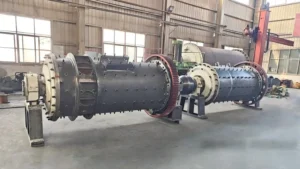
Rod mill coarse grinding circuit with crushed ore feed and wet discharge

Rod Mill Applications in Coarse Grinding Circuits

Rod mill coarse grinding applications use long steel rods to reduce crushed ore or mineral feed before ball milling, gravity separation, pemisahan magnetik, classification or a controlled coarse-product stage. Rod contact tends to act on larger particles first, so the mill can produce a comparatively narrow distribution with fewer unwanted fines when the material andRead more

Complete Raymond mill process flow for mineral powder production

Raymond Mill Process Flow for Mineral Powder Production

A Raymond mill process flow is a dry, air-swept grinding circuit that combines controlled feeding, roller-and-ring size reduction, air classification, coarse-particle return and finished-powder collection. Material and process air travel through connected but different paths, so stable powder production depends on both loops working together. Raymond Mill Process Flow at a Glance Crushing->Storage->Metered Feeding->Roller Grinding->AirRead more