
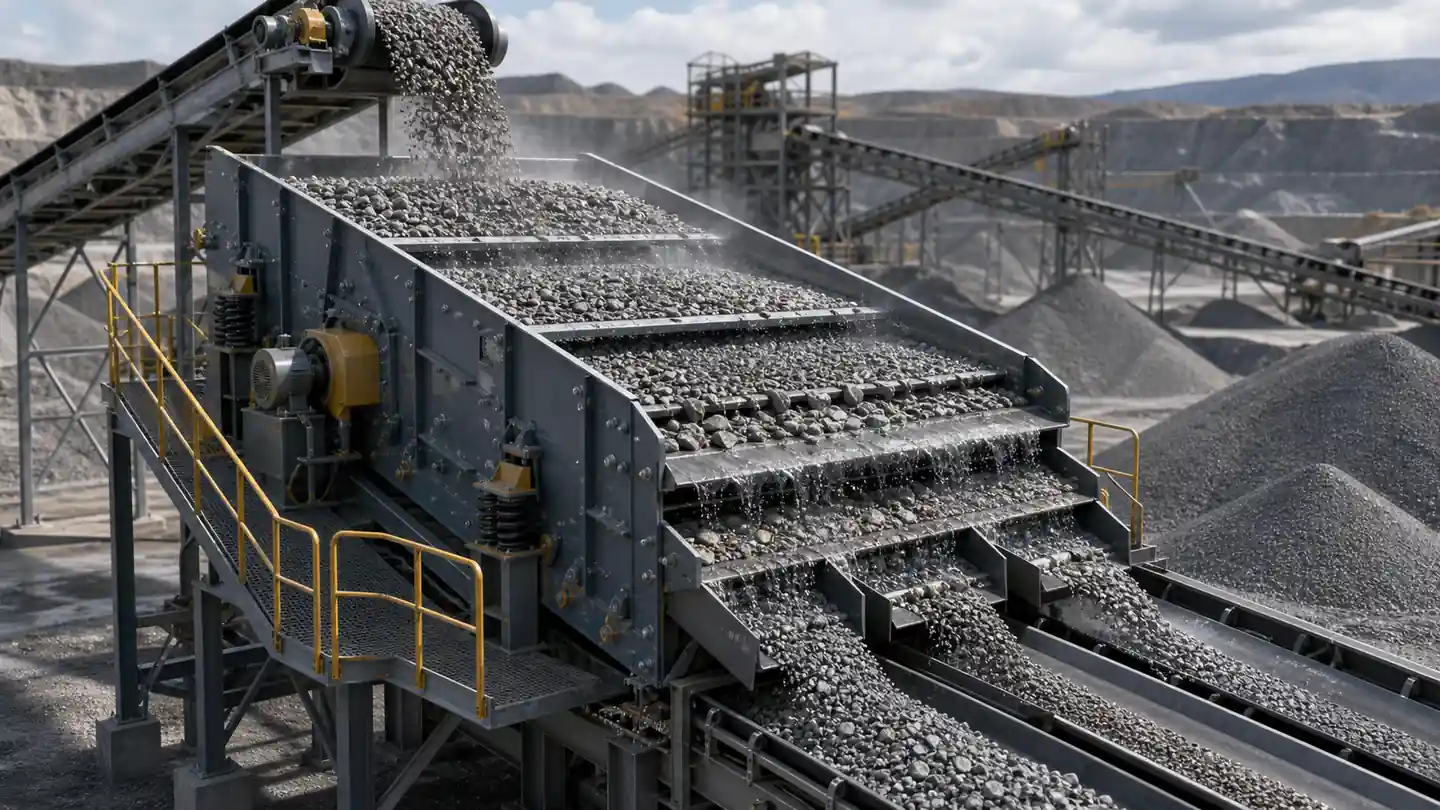
Vibrating screen efficiency factors include feed distribution, profundidad de la cama, the proportion of particles close to the aperture size, material moisture and clay, condición de los medios de pantalla, deck angle, vibration behavior and the time particles remain on the deck. Efficient separation depends on these factors working together. A larger screen or a higher vibration setting cannot correct an uneven feed, blinded openings or an unsuitable product cut by itself.
What Does Vibrating Screen Efficiency Mean?
Screening efficiency describes how correctly a screen separates material around the required cut size. The oversize stream should retain particles larger than the opening, while the undersize stream should receive particles small enough to pass. In practice, some fine particles remain in the oversize and some coarse particles can enter the undersize through damaged media, bypass points or elongated openings.
Throughput and separation quality are related but not identical. A deck can move a large mass while producing an inaccurate split. En cambio, an overly conservative feed rate may improve separation but fail the plant production target. The correct evaluation therefore combines dry mass flow with size analysis for the feed and both products.
The screen duty also matters. Scalping removes a coarse fraction before another stage, sizing produces controlled saleable fractions, and dewatering separates free water from solids. These duties use different media, motion and process evidence. El Vanore vibrating screen range must therefore be matched to a defined material and duty rather than an efficiency number alone.
The Main Vibrating Screen Efficiency Factors
| Factor | Por qué es importante | What to Observe | Useful Evidence |
|---|---|---|---|
| Distribución de pienso | Concentrated feed leaves part of the deck unused and creates a deep local bed. | Material coverage across the full usable width at the feed end. | Feed-box inspection, belt loading and samples across the deck width. |
| Bed depth and feed rate | A thicker bed increases the distance that undersize particles must travel to reach an opening. | Surging, deep piles, carryover and changing discharge density. | Dry mass flow, densidad aparente, feeder trend and bed observations. |
| Partículas cercanas a la apertura | Particles close to the opening size have fewer successful passage orientations. | A large quantity of material close to the required product boundary. | Detailed feed sieve analysis around the cut size. |
| Moisture and clay | Adhesion and agglomeration hinder stratification and can blind open area. | Sticky coatings, pegged apertures and damp fines attached to oversize. | Moisture by size fraction, clay behavior and wet/dry comparison tests. |
| Screen media | Aperture shape, open area, wear and tension influence passage and product accuracy. | Blocked, stretched, torn or unevenly worn panels. | Deck inspection, aperture checks and product contamination records. |
| Motion and inclination | They influence conveying velocity, particle presentation and residence time. | Slow transport, material throw, uneven travel or rapid discharge. | Verified machine settings, operating speed and condition measurements. |
| Mechanical condition | Loose components, unequal support or drive problems can change intended motion. | Abnormal noise, calor, movement, structural contact or uneven deck behavior. | Inspection history and measurements made under the manufacturer’s procedure. |
1. Feed Distribution Across the Deck
Uniform distribution is the first control point because the screen cannot use area that receives little material. A narrow central stream creates excessive local bed depth, while the outer deck sections contribute little separation. The feed box, chute geometry and material trajectory should spread the load without allowing impact to damage the media.
un establo alimentador vibratorio can reduce surges before the screen, but the chute must still deliver material across the deck. Operators should compare loading from side to side and inspect whether one discharge edge carries visibly more material. If distribution changes when the upstream crusher cycles, solve the surge and transfer issue before adjusting the screen drive.
2. Bed Depth, Stratification and Presentation Time
Once material reaches the moving deck, smaller particles must migrate through gaps between larger particles. This stratification exposes undersize to the screen surface. A deep bed gives lower particles a longer path to the deck, while rapid transport can reduce the number of opportunities to reach and pass an opening.
Reducing feed rate is not the only response. Uneven loading, excessive recirculating material, a changed crusher product or restricted discharge can all increase bed depth. Review the complete fixed crushing and screening line so that the screen receives a stable size distribution and mass flow.
3. Particle Size Distribution and Shape
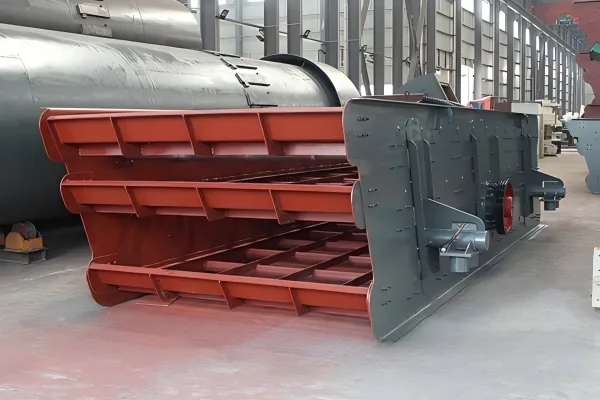
Particles much smaller than an unobstructed opening usually have a high probability of passage after they reach the deck. Separation becomes more difficult as particle size approaches the aperture. A feed containing a large near-size fraction can therefore require more effective area and presentation time than a feed with the same total mass but fewer near-size particles.
Shape also influences orientation. Flat or elongated particles may approach an opening differently from approximately equidimensional particles. Their passage behavior can affect both oversize contamination and the apparent cut of the deck. A detailed sieve analysis, supported by shape observations where relevant, is more useful than one nominal top-size figure.
4. Humedad, Clay and Screen Blinding
Surface moisture can bind fine particles to each other and to coarse particles. Clay can strengthen this agglomeration, restrict movement within the bed and fill apertures. The result is less effective open area and more fine material misplaced into the oversize stream. Conditions can also change after rain or when a new quarry face introduces different clay behavior.
Do not assume that adding water always solves the problem. Wet screening requires controlled spray distribution, drainage capacity and a downstream water-and-solids route. Depending on the material and product specification, the process may need washing, scrubbing or dewatering equipment. el más amplio gama de equipos de procesamiento de minerales shows how screening connects with preparation and separation stages.
5. Aperture, Open Area and Screen-Media Condition
The nominal aperture defines the intended separation boundary, but usable open area determines how much deck surface is available for passage. Pegged openings, adhered fines, loose tension, worn panels and tears alter that area. Damaged media can send oversize into the fine product, while blinding sends undersize into the coarse product.
Inspections should cover the complete deck, panel fasteners, side sealing and discharge transitions. Uneven wear often points to poor feed distribution or concentrated impact. Media replacement should restore the specified aperture and installation condition; changing aperture merely to compensate for another process problem can shift product gradation without correcting the cause.
6. Deck Angle, Motion and Mechanical Stability
Deck inclination and vibration behavior control how material is conveyed and presented to the surface. Faster travel can increase handling rate but shorten residence time. Slower travel can deepen the bed or restrict discharge if the feed exceeds the available carrying capacity. The useful setting depends on the machine design, abertura, feed and duty.
Operating adjustments must stay within the equipment manufacturer’s limits. Before changing them, inspect the drive, aspectos, springs or isolation elements, structural fasteners and support condition. Abnormal sound, temperature or motion can indicate a mechanical issue rather than a process setting. Screens can also create hazardous workplace noise, so plants should assess exposure and follow applicable controls; el NIOSH hearing-loss prevention guidance provides a non-commercial safety reference.
How to Diagnose Poor Screening Results
- Define the product problem. State whether the issue is fine material in oversize, coarse material in undersize, unstable throughput, blocked media or another measured result.
- Sample three streams. Collect representative feed, oversize and undersize samples during the same operating period and complete sieve analyses.
- Confirm the mass flow. Record dry feed rate where possible and note feeder surges, recirculating load and source changes.
- Inspect distribution and bed behavior. Check usable deck width, loading from side to side, local impact and material depth.
- Inspect open area. Look for blinding, pegging, tears, loose panels, bypass paths and uneven wear.
- Review moisture and clay. Compare current conditions with dry periods or representative wet-screening tests.
- Verify machine condition. Follow the manufacturer’s inspection procedure for drive, apoya, fasteners and motion.
- Change one controlled factor. Measure the resulting product split before making another adjustment.
Process Indicators Versus Machine-Condition Indicators
Process Indicators
Feed gradation, dry mass flow, humedad, comportamiento de la arcilla, product sieve analyses and misplaced material show whether the required separation is being achieved.
Deck Indicators
Distribución, profundidad de la cama, open area, panel wear, blinding and bypass reveal how effectively the material is using the screen surface.
Mechanical Indicators
Abnormal sound, calor, sujetadores sueltos, damaged supports or changed motion indicate a condition that requires inspection under the machine procedure.
These groups should be reviewed together. A clean deck does not prove that the product split is correct, and a poor product sample does not automatically identify the drive as the cause. Coordinated observations prevent repeated adjustments that move the symptom without resolving the underlying constraint.
Project Data Needed to Match a Screen Duty
Equipment matching begins with representative material data and a defined product requirement. Provide the feed size distribution, bulto más grande, densidad aparente, moisture range, comportamiento de la arcilla, particle shape where relevant, required cut sizes, product fractions, dry capacity range and operating schedule. The plant arrangement should also identify upstream equipment, return loads, disponibilidad de agua, support elevation, conveyor interfaces and access for maintenance.
For a new plant, the screen should be evaluated within the complete material balance. For an existing plant, synchronized operating records and samples help distinguish insufficient area from unstable feed, media condition or changed material. Vanore Mining can review these inputs and connect the screen with feeding, aplastante, washing or downstream processing equipment.
Vibrating Screen Efficiency FAQ
What is the first factor to check when screening efficiency falls?
Confirm the measured product problem, then check feed distribution and the available open area. Uneven loading and blocked or damaged media can change separation even when the drive settings have not changed.
Why do near-size particles make screening more difficult?
Particles close to the aperture size have a lower probability of finding a suitable position and passing through an opening. A high near-size fraction can therefore need more presentation time and effective screen area.
How does moisture affect a vibrating screen?
Moisture can make fine particles adhere, form agglomerates and blind apertures, especially when clay is present. The effect depends on the material, moisture distribution, aperture and whether the duty is dry or wet screening.
Does increasing vibration always improve screening?
No. Motion affects transport and particle presentation, but settings must remain within the machine design and suit the feed and duty. Excessive or unsuitable adjustment cannot correct poor distribution, blinding or damaged media.
What samples are needed to calculate screening performance?
Collect representative feed, oversize and undersize samples during the same stable operating period. Determine dry mass flow and complete size analyses for all three streams so misplaced coarse and fine material can be quantified.