
A Raymond mill process flow is a dry, air-swept grinding circuit that combines controlled feeding, roller-and-ring size reduction, air classification, coarse-particle return and finished-powder collection. Material and process air travel through connected but different paths, so stable powder production depends on both loops working together.
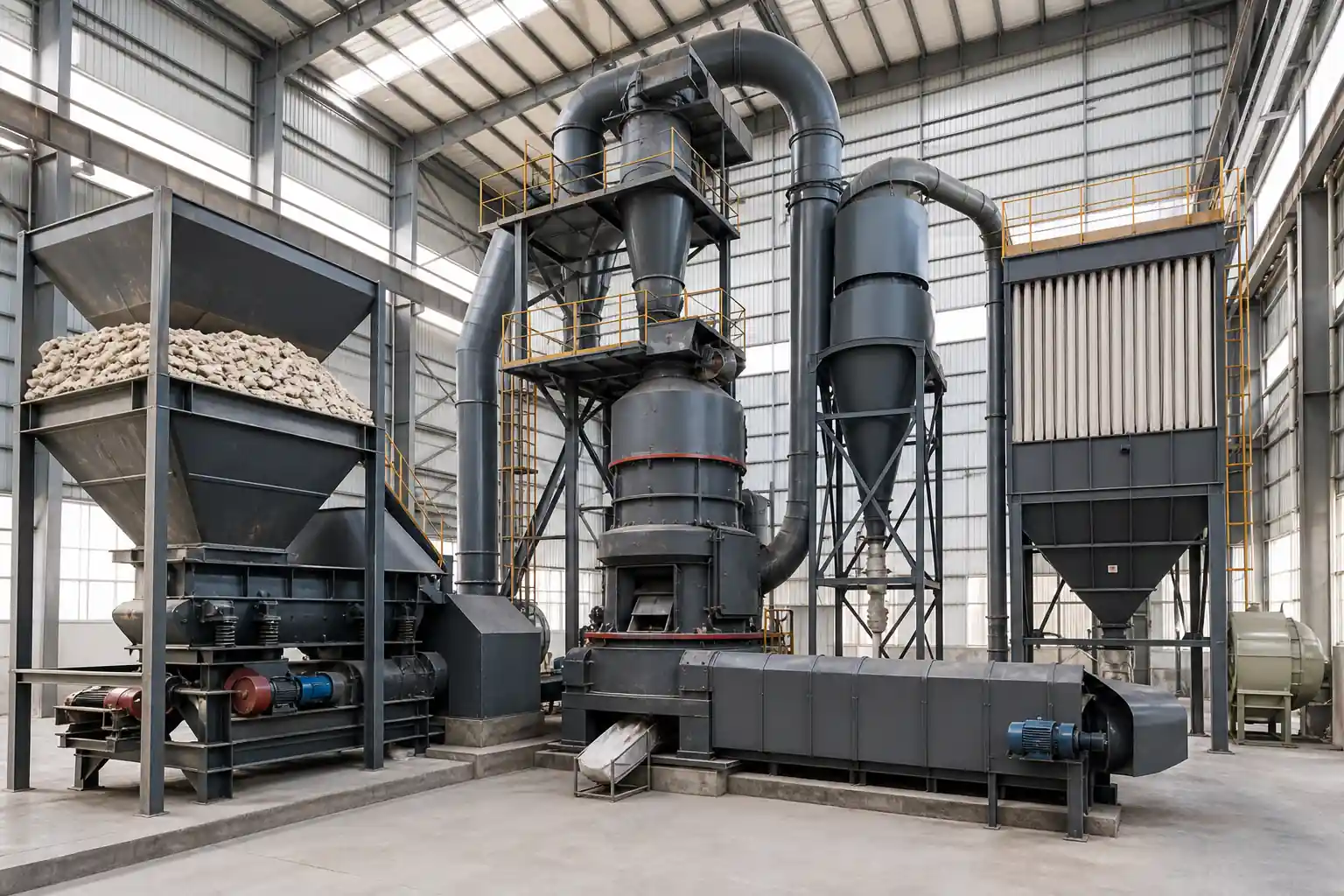
Raymond Mill Process Flow at a Glance
The main material route begins with suitably prepared mineral feed. A hopper and feeder deliver the material to the mill, where rollers press it against a stationary grinding ring. Air lifts reduced particles to the classifier. Qualified fines continue to collection, while coarse rejects fall back for further grinding.
Mientras tanto, the process-air route carries powder, supports classification and returns through the fan or final filtration section. This closed or partly recirculating air arrangement distinguishes the system from a simple mechanical grinder.
Escenario 1: Raw Material Preparation
Raymond mills normally receive dry, crushed feed rather than large run-of-mine rock. Upstream crushing reduces the raw mineral to a size that suits the mill inlet and grinding zone. Screening or another separation step can remove isolated oversize pieces before storage.
Material characteristics matter as much as nominal size. Dureza, abrasividad, humedad, density and clay content influence grinding behavior, air transport and powder collection. Representative material testing should therefore guide the equipment configuration.
Escenario 2: Storage and Controlled Feeding
A storage hopper or bin provides a buffer between crushing and grinding. The discharge arrangement should maintain consistent flow and reduce bridging or sudden surges. Below the hopper, a alimentador vibratorio or another metering device controls the mass flow entering the mill.
Stable feeding keeps the grinding zone from alternating between underloaded and overloaded conditions. Además, a sealed feed connection or air-lock device helps protect the pressure balance in an air-swept system.
Escenario 3: Roller-and-Ring Grinding
Inside the Raymond mill, a vertical main shaft rotates a carrier fitted with pendulum roller assemblies. Centrifugal force moves the rollers outward against the stationary grinding ring. Plows or shovels lift material from the mill floor and direct it into the contact zone between the rollers and ring.
Repeated compression, attrition and impact reduce the particles. The process does not send every particle through the mill only once. Material circulates within the grinding chamber until airflow can carry it toward classification.
Escenario 4: Air Transport and Classification
Process air enters the lower mill and moves upward through the grinding chamber. It entrains particles light enough to leave the grinding zone and carries them toward an integrated or connected classifier.
The classifier separates material according to particle behavior in the air stream. In a dynamic classifier, rotor speed contributes to the selected cut. Air volume, classifier design, particle density and particle shape also influence the resulting powder distribution. A related powder separator can support external or downstream classification duties in selected plant layouts.
Escenario 5: Coarse Powder Return
Particles that do not meet the classifier cut lose momentum and return toward the grinding chamber. This internal coarse return creates a closed grinding-and-classification loop. The rollers then reduce the rejected material further instead of sending it forward as finished powder.
Excessive coarse return can indicate a change in feed, material grindability, classifier setting, airflow or wear condition. Sin embargo, the return itself is a normal part of the circuit and helps control the top size of the collected product.
Escenario 6: Cyclone Powder Collection
Qualified powder leaves the classifier with the conveying air and enters a cyclone collector or another primary collection device. The cyclone creates a rotating flow that moves particles toward the outer wall. Powder then travels downward to the discharge, while the separated air exits through the upper section.
A rotary valve, screw conveyor or enclosed transfer system can move the finished powder toward storage, packing or a downstream process. The discharge equipment should limit uncontrolled air leakage and maintain steady powder flow.
Escenario 7: Air Recirculation and Dust Filtration
After cyclone separation, the process air can return toward the fan and mill. Moisture evaporation, leakage and process conditions may create excess air, so the system can direct a controlled portion toward a colector de polvo. Final filtration removes residual fine particles before cleaned air leaves the system.
Duct sealing, fan condition, collector resistance and discharge-valve operation all affect air balance. Como consecuencia, powder transport and classification should be reviewed as part of one connected air circuit.
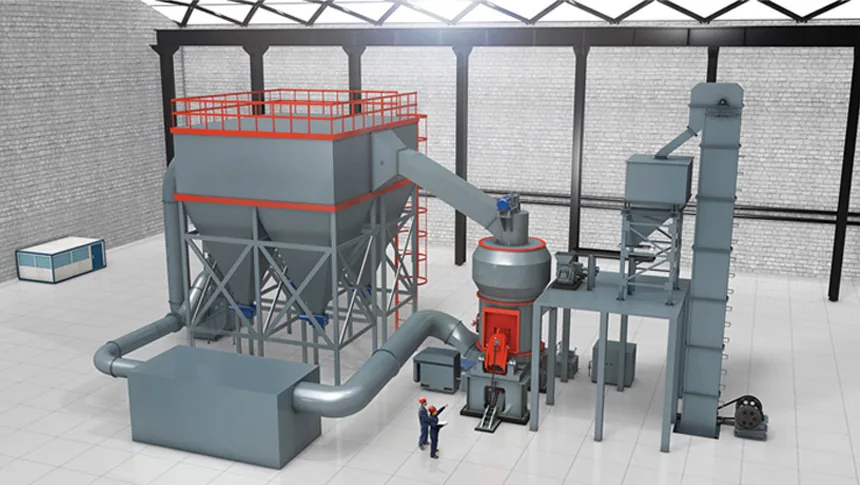
Material Flow and Airflow Are Different
| Flow | Starting Point | Main Route | Return or Discharge |
|---|---|---|---|
| Raw material | Crusher discharge, hopper or storage bin | Feeder to grinding chamber | Reduced particles enter the air stream |
| Coarse powder | Classifier reject | Gravity or internal circulation back toward the mill | Returns to the roller-and-ring grinding zone |
| Qualified powder | Classifier fines outlet | Air duct to cyclone or filter collection | Finished-powder discharge and storage |
| Process air | Fan and mill air inlet | Grinding chamber, classifier and collector | Recirculation plus controlled final filtration |
Separating these routes makes fault analysis clearer. A feed interruption belongs to the raw-material path, while unstable classification may originate in the air circuit, classifier or material condition. Powder discharge problems can occur even when the mill continues grinding normally.
Equipment Roles in a Raymond Mill Powder Line
| Equipo | Papel de la planta | Receives | Delivers |
|---|---|---|---|
| Trituradora | Prepares raw mineral feed for milling. | Larger dry mineral material | Controlled crushed feed |
| Tolva y alimentador | Buffers and meters material into the mill. | Crushed material | Continuous mill feed |
| Raymond mill | Reduces particles between pendulum rollers and the grinding ring. | Metered crushed feed | Airborne ground material |
| Classifier | Separates qualified fines from coarse material. | Air and ground particles | Fines to collection and coarse return to grinding |
| Cyclone collector | Separates most product powder from conveying air. | Air and qualified powder | Powder discharge and separated air |
| Fan and filter | Move process air and capture residual fines. | Return or excess process air | Recirculated or cleaned air |
What Controls Finished Powder Fineness?
Classifier setting is important, but it does not act alone. The finished product reflects the combined behavior of feeding, molienda, airflow and collection.
| Variable | Process Effect | Review Together With |
|---|---|---|
| Classifier setting | Changes the separation of fines and coarse rejects. | Rotor condition, airflow and product-size analysis |
| Air volume | Influences particle transport, classification and collector loading. | Fan, dampers, duct leakage and filter resistance |
| Tasa de alimentación | Changes the material load presented to the grinding zone and classifier. | Feeder output, motor load and coarse return |
| Material properties | Dureza, humedad, density and shape affect grinding and air separation. | Representative testing and feed consistency |
| Roller and ring condition | Wear changes the effective grinding contact and circulating material behavior. | Inspection, vibración, power and product trend |

Optional Drying and Material Moisture
Some air-swept roller mill systems can introduce heated process air to remove limited moisture during grinding. This feature depends on the material, fuente de calor, air system, collector design and required powder quality. It should not be assumed for every Raymond mill installation.
When the raw material contains more moisture than the grinding circuit can manage, a separate secador rotatorio or another pre-drying stage may be appropriate. Pre-drying can improve flow into the hopper and feeder while reducing the drying duty inside the mill.
System Configuration Depends on the Material
Raymond mills are commonly considered for soft to medium-hard non-metallic minerals and dry powder applications. Caliza, dolomita, yeso, talc, barite, bentonite and similar materials may require different wear protection, alimentación, classification and collection arrangements.
el más amplio grinding mill range also includes other equipment for ore grinding, fine powder and special process duties. Mill selection should begin with representative material properties, required product distribution, capacidad, humedad, abrasiveness and downstream use.
Raymond Mill Process Flow FAQ
What is the basic Raymond mill process flow?
The basic flow is raw-material preparation, almacenamiento, controlled feeding, roller-and-ring grinding, air classification, coarse-particle return, qualified-powder collection and dust filtration. The exact arrangement depends on the material and required powder.
Why does coarse powder return to the Raymond mill?
The classifier rejects particles that do not meet the selected cut. Gravity and internal flow return this coarse fraction to the grinding zone so the rollers can reduce it further.
What does the classifier control in a Raymond mill system?
The classifier controls which particles leave the grinding circuit with the process air. Classifier design, rotor speed where applicable, airflow and material behavior all influence the finished powder distribution.
What is the role of the cyclone collector?
The cyclone collector separates most qualified powder from the conveying air by centrifugal action. Collected powder leaves through the lower discharge, while the air continues toward recirculation or final filtration.
Can a Raymond mill grind wet material?
Material moisture affects flow, grinding and air handling. Some air-swept systems can use heated air for limited drying, while wetter feed may require separate pre-drying. Material testing and system design should define the suitable arrangement.