
Screening before grinding separates crushed ore that already meets the mill-feed requirement from oversize that still needs reduction. Screen undersize moves to fine-ore storage or controlled mill feed, while oversize returns to a crusher. This limits unnecessary breakage, controls the maximum feed size and gives the grinding circuit a more consistent size distribution. The actual screen aperture and circuit arrangement must come from representative ore tests, crusher product data and the mill-feed requirement.
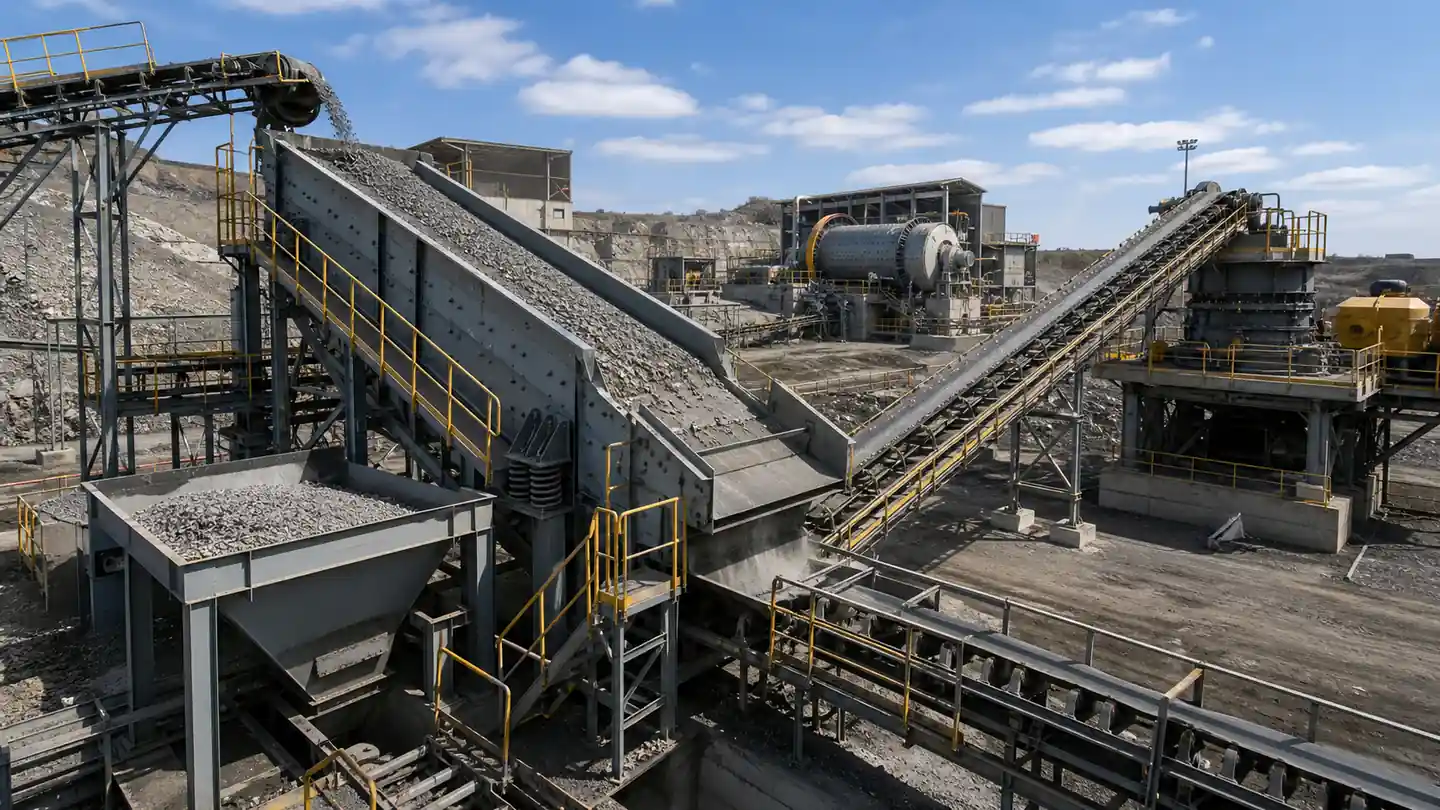
What Screening Changes Before the Grinding Circuit
A crusher does not produce one uniform particle size. Its discharge contains coarse particles, near-size particles and material already fine enough for the next process. Sending the whole stream back through another crusher would add unnecessary breakage to the acceptable fraction. A correctly placed vibrating screen for mineral processing separates those fractions before grinding.
The principal benefit is feed control. The screen aperture establishes a physical upper boundary for the undersize stream, although aperture alone does not define the complete product distribution. Screen loading, forma de partícula, umidade, argila, deck motion and the proportion close to the aperture all influence separation. For this reason, the screen must be evaluated as part of the crushing circuit rather than as an isolated machine.
Os EUA. Environmental Protection Agency describes crushing and screening as linked stages in metallic mineral processing, with screens used to route material according to size. Its metallic mineral processing technical background also distinguishes these coarse preparation operations from subsequent grinding. That distinction is important: pre-grinding screening controls crushed feed, while classification after grinding separates much finer material.
Oversize Return and Undersize Bypass
Em um circuito fechado de britagem, screen oversize normally returns to the selected secondary or tertiary crusher. The return point depends on the crusher chamber, feed-size limit, duty and required final product. For hard-rock circuits, um cone crusher in secondary or tertiary duty may operate with the screen. Other ores and applications may require a different crushing principle.
Screen undersize can move directly toward grinding, but direct transfer is not always the best arrangement. A fine-ore bin, stockpile or surge hopper can buffer short fluctuations in crushing and screening. A controlled feeder then meters the material into the mill. This separation of operating stages is useful when mine delivery, crusher discharge or screen loading changes more quickly than the grinding circuit should respond.
Equipment Roles in a Pre-Grinding Screening Circuit
Screening performance depends on the equipment before and after the screen. The following roles describe a typical closed crushing and pre-grinding arrangement; they are not a fixed flowsheet for every ore.
| Equipamento | Primary Role | Information Needed | Operating Relationship |
|---|---|---|---|
| Funil e alimentador | Provide controlled, distributed feed to the crusher | Maior caroço, densidade aparente, umidade, clay and required flow range | Unstable feeding changes crusher product and screen bed depth |
| Triturador | Reduce oversize ore to a product suitable for screening | Distribuição de ração, dureza, abrasion and target product | Crusher setting and chamber condition shape the screen feed distribution |
| Tela vibratória | Separate acceptable mill feed from coarse return material | Required cut, rendimento, umidade, near-size fraction and particle shape | Aperture, área, motion and feed presentation influence separation |
| Transportador de retorno | Carry oversize back to the selected crushing stage | Peak return flow, lift, route and transfer conditions | Its capacity must accommodate circulating material without restricting the screen |
| Fine-ore storage | Buffer short-term differences between crushing and grinding | Required live capacity, flow behavior and reclaim method | Poor flow or segregation can still create variable mill feed |
| Mill feeder | Meter screened ore into the grinding circuit | Mill feed range, control philosophy and measurement method | Steady reclaim supports consistent mill loading and process control |
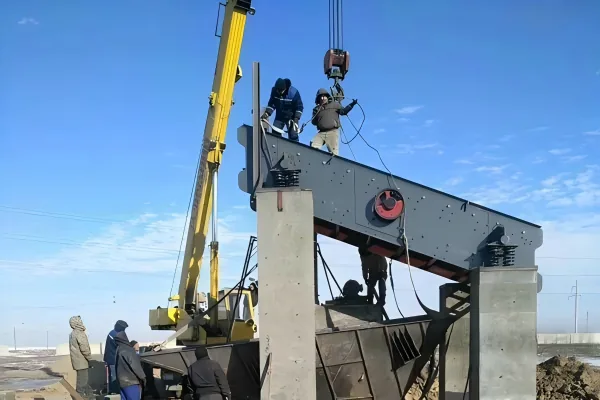
Screen Selection Factors That Matter
The required separation size is only the starting point. A screen must provide enough effective area and suitable motion for the expected mass flow and feed composition. The decision should use a representative size analysis that includes the percentage above, below and close to the proposed aperture.
- Distribuição do tamanho do feed: defines the amount of oversize, undersize and near-size material reaching each deck.
- Required separation size: should match the downstream mill-feed basis and the product achievable by the crusher.
- Near-size fraction: particles close to the aperture are generally more difficult to separate than clearly coarse or clearly fine particles.
- Umidade e argila: can cause agglomeration, blinding or poor stratification, particularly where fine particles coat larger rock.
- Particle shape: elongated or flat particles may pass an aperture differently from more equidimensional particles.
- Feed presentation: uneven distribution across the deck reduces effective area and creates local overloading.
- Deck motion and inclination: influence transport, stratification and the time available for particles to encounter apertures.
- Screen media: aperture form, open area, wear life and resistance to pegging must suit the ore and maintenance plan.
No universal screen aperture, efficiency or loading figure applies to all grinding circuits. Wet or sticky ore can behave very differently from a dry laboratory sample, while wear can change the effective opening over time. Pilot screening, vendor sizing and operating data from representative material provide a stronger basis than a generic capacity value.
How Screening Affects Mill Feed
A screen limits the coarsest particles entering grinding and removes oversize that could disrupt the selected mill-feed basis. This does not guarantee a specific increase in throughput or reduction in energy use. Mill response also depends on ore hardness, distribuição de ração, mill dimensions, mídia, pulp conditions and classifier performance.
No entanto, a bounded feed-size distribution gives the grinding circuit a clearer operating condition. Large shifts in top size can alter breakage behavior and retention within a moinho de bolas para moagem de minério. Da mesma maneira, sudden changes in solids flow can disturb mill loading. Fine-ore storage and controlled reclaim therefore complement the screen instead of replacing it.
Operators should compare samples from screen feed, oversize and undersize rather than relying only on visual observation. The screen balance shows whether correctly sized material is returning to the crusher, whether coarse particles are entering the undersize and how circulating material changes with ore condition. These measurements connect screen performance to crusher adjustment and mill-feed control.

Screening Before Grinding and Classification After Grinding
Pre-grinding screening and post-grinding classification both separate particles, but they work at different points and often rely on different physical behavior. Confusing the two can lead to an incomplete circuit description.
| Aspect | Screening Before Grinding | Classification After Grinding |
|---|---|---|
| Material condition | Minério triturado, commonly handled as a coarse dry or wet-solid stream | Fine mill discharge, commonly handled as slurry in wet circuits |
| Main purpose | Bypass acceptable crushed material and return oversize for more crushing | Send suitably fine material forward and return coarse material to the mill |
| Separation basis | Physical aperture and the probability of particles passing through it | Settling and hydraulic behavior, or fine apertures when fine screens are used |
| Typical equipment | Tela parda ou vibratória | Hidrociclone, classificador espiral ou tela fina |
| Key control concern | Carregamento do convés, cegante, aperture condition and oversize return | Fluxo, pressão, densidade da polpa, cut behavior and circulating load |
Many plants use both stages. The screen closes the final crushing stage before the fine-ore system, while the classifier closes the grinding mill circuit. Each stage needs its own sampling points and performance checks.
Common Screening Problems and Evidence to Check
Visible oversize in the undersize stream or excessive material returning to the crusher indicates a symptom, not necessarily one cause. Corrective work should begin with measurements and inspection.
- Blinded or pegged apertures: inspect the deck and compare performance across changes in moisture, clay and screen media condition.
- Uneven bed depth: check the feed chute, distribution across the deck and feeder stability before changing the screen.
- Excessive return flow: sample crusher discharge and screen streams; the issue may originate in crusher setting, chamber wear or an unsuitable target cut.
- Coarse leakage into undersize: inspect damaged media, panel fastening, aperture wear and bypass paths around the deck.
- Low effective capacity: review actual tonnage, densidade aparente, near-size fraction, motion and available open area using representative conditions.
- Variable mill feed: assess the complete path from screen undersize through storage and reclaim, because segregation or erratic feeding may occur after screening.
Trend data and routine size analyses are more useful than a single inspection. They show whether a change improves separation under different ore conditions and whether the improvement is sustained as media wears.
Project Data Needed for a Pre-Grinding Screen
A reliable equipment proposal requires the process requirement and the expected variation, not only a nominal hourly capacity. The minimum data set should include representative feed-size distributions, maior caroço, dry throughput range, densidade aparente, umidade, comportamento de argila, ore hardness and abrasion, proposed crusher product, required mill-feed top size, horário de funcionamento, arranjo de convés, site elevation and available installation space.
The project team should also define where oversize returns, how undersize is stored or reclaimed, how each stream will be sampled and whether water or dust controls are required. These interfaces determine chute positions, conveyor duty, support arrangement and access for screen-media replacement. Vanore Mining’s mineral processing equipment range can be reviewed as part of the connected crushing, screening and grinding line.
Screening Before Grinding FAQ
Why is screening used before grinding?
Screening separates crushed ore that already meets the mill-feed requirement from oversize that needs more crushing. This bypass limits unnecessary breakage and helps the grinding circuit receive a more controlled feed-size distribution.
Where does screen oversize go before grinding?
Em um circuito fechado de britagem, oversize normally returns to the selected secondary or tertiary crusher. The exact return point depends on crusher duty, screen position, ore characteristics and the required final crushing product.
Does screen undersize always feed the mill directly?
Not always. Undersize may enter a fine-ore bin, surge stockpile or controlled feeder before the mill. Storage and reclaim can separate short-term crusher and screen fluctuations from grinding operation.
What causes poor screening before a grinding mill?
Common causes include excessive loading, uneven feed presentation, high near-size content, wet or clay-bearing ore, blocked apertures, worn media, incorrect motion and unstable upstream flow. Feed and product samples are needed to identify the actual cause.
Is screening before grinding the same as classification after grinding?
Não. Pre-grinding screens usually separate relatively coarse crushed ore by aperture. Post-grinding classifiers handle finer material and commonly use settling, hydraulic or fine-screening behavior to return coarse particles to the mill.