
Ball mill circulating load is the dry-solids flow returned for further grinding, expressed here as a percentage of fresh circuit feed: carga circulante (%) = returned dry solids / fresh dry solids x 100. A return of 200 dry t/h with 100 dry t/h of fresh feed therefore gives 200%. The percentage describes internal recirculation, not new production or grinding efficiency. Always check which streams a report uses: total mill feed divided by fresh feed is a different ratio.
Define the circuit before choosing a formula
Consider a simple closed circuit in which fresh feed enters the mill together with classifier return. Mill discharge goes to the classifier, which sends one stream onward as circuit product and returns the other stream to the mill. In a cyclone circuit, these are normally the overflow and underflow respectively.
For this arrangement, use four dry-solids flow rates:
- F: fresh feed entering the grinding circuit.
- R: classifier return going back to the mill.
- M: total mill feed, equal to F + R.
- P: circuit product leaving the classifier.
At steady state, without side streams, material loss or a change in the circuit’s solids inventory, P = F. The return-to-fresh-feed ratio is R/F, while the total-mill-feed ratio is M/F = 1 + R/F. For this circuit, a return ratio of 2.0 and a mill-feed ratio of 3.0 describe the same flows. Label the stream pair, not just the abbreviation CLR.
Other arrangements introduce fresh feed ahead of the classifier or include additional grinding stages. Their stream relationships must be drawn and balanced separately. Quanto mais amplo circuito de classificação de moinho de bolas explanation describes how grinding and separation work together.
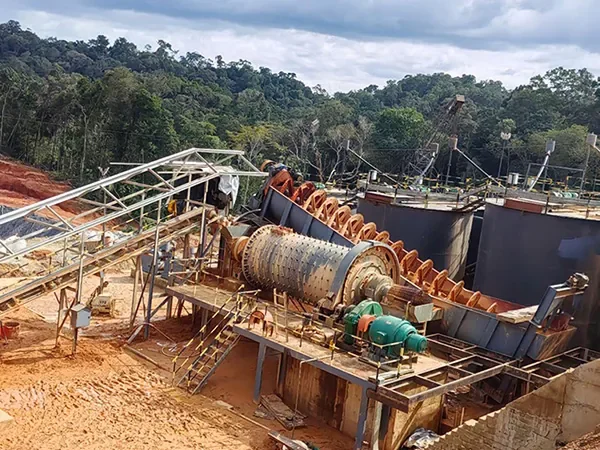
A worked ball mill circulating load calculation
Assume a steady circuit receives 100 dry t/h of fresh ore and returns 200 dry t/h from classification. These values are a teaching example, not a plant operating result.
| Fluxo | Dry solids | Balance relationship |
|---|---|---|
| Fresh feed, F | 100 t/h | New material entering the circuit |
| Classifier return, R | 200 t/h | Material sent back for another pass |
| Total mill feed, M | 300 t/h | F + R = 100 + 200 |
| Circuit product, P | 100 t/h | P = F at steady state |
Circulating load = (200 / 100) x 100 = 200%. Enquanto isso, M/F = 300/100 = 3.0. Reporting 300 t/h as new plant production would count recirculating solids as though they were fresh ore.
Two balances check the arithmetic: the mill receives 100 + 200 = 300 dry t/h, and the classifier divides 300 into 200 returned plus 100 leaving the circuit. The net circuit input and output are both 100 dry t/h.
Keep the units consistent. Here, t/h means metric tonnes per hour, with one tonne equal to 1000 kg, as listed in NIST’s mass-unit guidance. Do not mix short tons with metric tonnes.
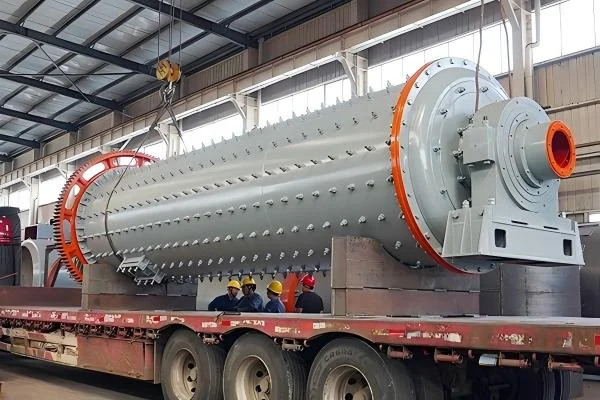
Use dry solids, not slurry volume
Water added around a wet-grinding circuit changes slurry flow without adding ore. Comparing a slurry-volume reading in one stream with a dry belt-feed reading in another does not produce a valid circulating-load ratio.
When flow is measured as slurry volume, the dry-solids rate requires both slurry density and the solids mass fraction:
Dry-solids rate = slurry volume rate x slurry density x solids mass fraction.
Por exemplo, 100 eu3/h of slurry at 1.5 t/m3 e 60% solids by mass contains 90 dry t/h: 100 x 1.5 x 0.60. The density here is slurry density, not mineral particle density; the solids value is a mass fraction, not a volume fraction.
Changes in water addition can therefore alter pump readings even when the dry return rate is unchanged. O wet-grinding process article covers the slurry context.
Estimate return flow from classifier size samples
If reliable direct solids-flow measurements are unavailable, a size balance can estimate R/P. Take representative samples of classifier feed, product and return over the same stable operating period. At one common sieve size, define the mass fractions passing as um, b e c, respectively.
The classifier balances are S = R + P and S x a = R x c + P x b, where S is classifier-feed dry solids. Rearranging gives:
R/P = (b – um) / (um – c). For the simple steady circuit defined above, P = F, so this also gives R/F.
Suppose classifier feed is 40% passing, product is 80% passing and return is 20% passing the selected size. Then R/P = (0.80 – 0.40)/(0.40 – 0.20) = 2.0, ou 200%. With P = 100 dry t/h, the calculated return is 200 dry t/h, matching the earlier example.
The calculation becomes sensitive to sampling error when a and c are close. If the classifier feed and return have almost identical passing fractions, their small difference cannot support a confident ratio. Check sample representativeness, sieve results and the circuit balance instead of accepting every numerical output.
In this example, both the total-solids balance and the selected-size balance close. Size passing the classifier feed is 300 x 0.40 = 120 dry t/h; the two outgoing streams contain 100 x 0.80 + 200 x 0.20 = 120 dry t/h passing that size.
Why 250% is not an automatic plant target
UM 250% circulating load is a specified condition in the conventional locked-cycle Bond ball-mill grindability test. That laboratory procedure is designed to obtain a reproducible test result. Its percentage alone does not establish the best operating point of an industrial circuit.
Plant performance also depends on classification sharpness, fines returning with the coarse stream, ore breakage behavior and the capacity of the mill, pumps and classifier. A high return rate can send useful coarse material back for grinding, but it can also recirculate already-fine material. A lower rate can accompany improved separation, or it can indicate that coarse particles are escaping into the product.
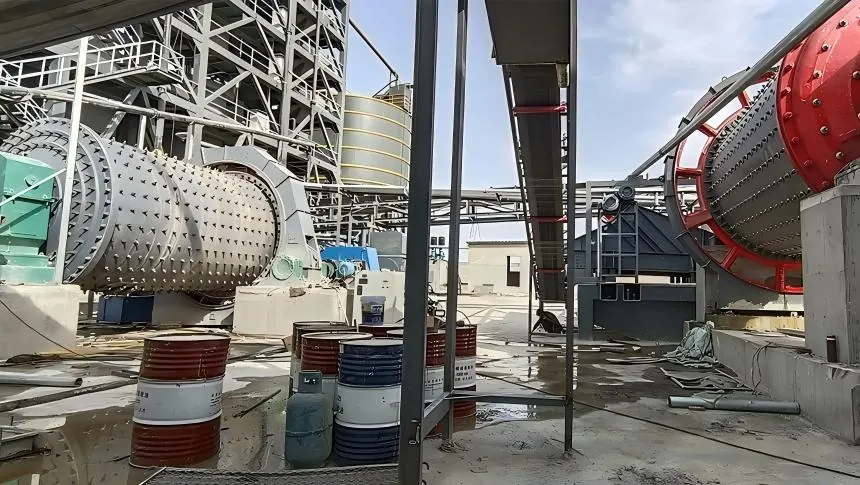
Interpret the percentage with the product
Consider two possible survey outcomes. In the first, return flow increases while product grading remains acceptable and fresh-feed throughput rises within equipment limits. The extra internal flow may be supporting useful grinding. In the second, return flow increases but fresh throughput does not, and more finished-size material returns to the mill. The same direction of change points toward a different investigation.
Da mesma maneira, a lower circulating load is not a success if the product becomes too coarse for the next separation stage. Compare the full size distribution and, where needed, mineral liberation requirements, rather than treating a single percentage as the result.
When evaluating a ball mill installation, keep fresh-feed rate, dry return rate, product grading and equipment constraints together. An apparent improvement that only changes water flow, accumulates solids in a sump or shifts oversize downstream has not demonstrated a better grinding circuit.